

Heartbreak
is unpreventable . . .

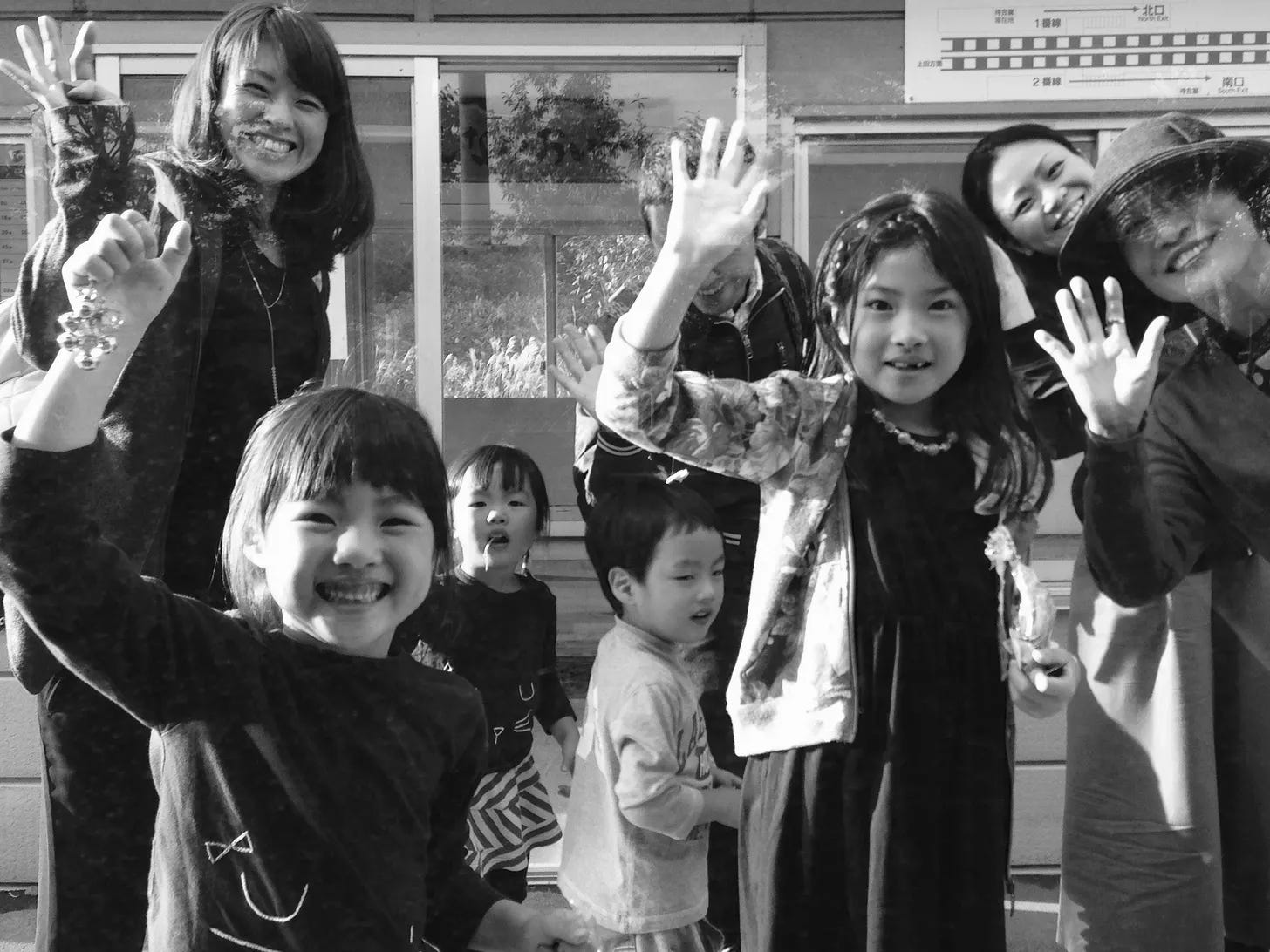
We tend to think of 'enlightenment' as an abstract, as being a state above all suffering, but Buddha asked his followers in very intimate terms to follow heartbreak to its very end, to see it as part of any ultimate understanding, in effect to say the very last goodbye, to be completely present to 'everything ceasing', to everything we are constantly being asked to let go of, to the very origin of our pain, and thereby to let it flower into something else. I ran into this lovely family group for only a very brief train ride through the mountains of central Japan, but the chemistry and poignancy of the encounter and the tidal manner in which they suddenly had to leave, and the image they left in my camera, waving to me from an obscure country station platform, seemed to embody all the hellos and goodbyes I had ever made. -DW
Heartbreak
is unpreventable: the natural outcome of caring for people and things over which we have no control, of holding in our affections those who inevitably move beyond our line of sight. Even the longest marriage has had its heart broken many times just in the many acts of staying together.
Heartbreak begins the moment we are asked to let go but cannot. In other words, it colours and inhabits and magnifies each and every day. Heartbreak is not a visitation, but a path that human beings follow through even the most average life. Heartbreak is an indication of our sincerity: in a love relationship, in a life’s work, in trying to learn a musical instrument, in the attempt to shape a better, more generous self. Heartbreak is the beautifully helpless side of love and affection, and is just as much an essence and emblem of care as the spiritual athlete’s quick but abstract ability to let go. Heartbreak has its own way of inhabiting time, and its own beautiful and trying patience in coming and going.
Heartbreak is how we mature. Yet we use the word ‘heartbreak’ as if it only occurs when things have gone wrong: an unrequited love, a shattered dream, a child lost before their time. Heartbreak, we hope, is something we can avoid; something to guard against, a chasm to be carefully looked for and then walked around. The hope is to find a way to place our feet where the elemental forces of life will keep us in the manner to which we want to be accustomed and which will keep us from the losses that all other human beings have experienced, without exception, since the beginning of conscious time. But heartbreak may be the very essence of being human, of being on the journey from here to there, and of coming to care deeply for what we find along the way.
Our hope to circumvent heartbreak in adulthood is beautifully and ironically childlike: heartbreak is as inescapable and inevitable as breathing, a part and a parcel of every path, asking for its due in every sincere course an individual takes. It may be that there may be not only no real life without the raw revelation of heartbreak but no single path we can take within a life that will allow us to escape without having that imaginative organ we call the heart broken by what it holds and then has to let go.
In a sobering physical sense, every heart does eventually break, as the precipitating reason for death or because the rest of the body has given up before it and it can no longer sustain its steady beat. But hearts also break in an imaginative and psychological sense: there is almost no path a human being can follow that does not lead to heartbreak. A marriage, a committed vow to another, even in the most settled, loving relationship, will always break our hearts at one time or another; as mentioned, a successful marriage has often had its heart broken many times just in order for the couple to stay together; parenthood, no matter the sincerity of our love for a child, will always break the mould of our motherly or fatherly hopes; a good work, seriously taken, will often take everything we have and still leave us wanting; and finally, even the most self-compassionate self-examination should, if we are sincere, lead eventually to existential disappointment.
Realising its inescapable nature, we can see heartbreak not as the end of the road or the cessation of hope but as the close embrace of the essence of what we have wanted or are about to lose. It is the hidden DNA of our relationship with life, outlining outer forms even when we do not feel it by the intimate physical experience generated by its absence; it can also ground us truly in whatever grief we are experiencing, set us to planting a seed with what we have left, or appreciate what we have built even as we stand in its ruins.
If heartbreak is inevitable and inescapable, it might be asking us to look for it and make friends with it, to see it as our constant and instructive companion, and even perhaps in the depth of its impact, as well as in its hindsight, to see it as its own reward. Heartbreak asks us not to look for an alternative path, because there is no alternative path. It is an introduction to what we love and have loved, an inescapable and often beautiful question, something or someone that has been with us all along, asking us to be ready to let go of the way we are holding things, and preparation perhaps for the last letting go of all.
-from Consolations: The Solace, Nourishment and Underlying Meaning of Everyday Words
We tend to think of 'enlightenment' as an abstract, as being a state above all suffering, but Buddha asked his followers in very intimate terms to follow heartbreak to its very end, to see it as part of any ultimate understanding, in effect to say the very last goodbye, to be completely present to 'everything ceasing', to everything we are constantly being asked to let go of, to the very origin of our pain, and thereby to let it flower into something else. I ran into this lovely family group for only a very brief train ride through the mountains of central Japan, but the chemistry and poignancy of the encounter and the tidal manner in which they suddenly had to leave, and the image they left in my camera, waving to me from an obscure country station platform, seemed to embody all the hellos and goodbyes I had ever made. -DW
I must have read and studied this piece in my book of Consolations over one hundred times as I was going through my divorce. Up until this point, I'd thought heartbreak was something to be avoided. Allowing the terror involved with coming into alignment with my own truth has changed my life and the orientation I have to my own choices.
I didn't die. Heartbreak broke me open.